


I Want to Live, I Want to be Happy and Love ...
- Shabin Mere
- Dec 5, 2023
- 9 min read

Updated: Dec 9, 2023

Let's talk about the Missing and Murdered Indigenous Women and Girls (MMIWG)
In my course reflection post, I mentioned that my theme has always focused on
Community Health Services, and for my final post for this course, I want to cover a topic that has been a global discussion for many years. In this post, I want to further elaborate on the vulnerable population and Indigenous women, specifically the Missing and Murdered Indigenous Women and Girls (MMIWG) who have faced decades of injustice, inequities, and cultural, social, and sexual discrimination. "Former leaders have denounced the need for further study of what causes such high rates, likening it to mere crimes – but it is evident that there may be social and cultural forces at play" (Wu, 2016).
In 2014, the former Canadian Prime Minister expressed that "police investigations,
not a national inquiry, are the best way to deal with crimes involving missing and murdered aboriginal women" and that such "cases are addressed -- and solved -- by the police" (Canadian Press, 2014). He further stated that 'it's important to keep in mind that these are crimes' .... [and] [w]e should not view this as sociological phenomenon' (Harper, 2014, as cited in Canadian Press, 2014).
Applying the Socio-Eological Model to This Situation

In this discussion, I
aim to apply the
Socio-ecological Multilevel Approach
model bringing the layers together in the topic of MMIWG. Creating services within a community involves networks of organizations and social institutions that develop as a response to individual and interpersonal needs, including those required for vulnerable and marginalized populations. The types of populations within a community, their socio-economic status, and ease or challenges in accessing health care are elements that help identify the health of a community and the social determinants of health for that population. Additionally, the layers of Public Policy, Community, and Organizations within this model are thereby identified based on those determinants and developed or revised according to the needs of the community.
A Long Standing Human Rights Crisis
MMIWG refers to a human rights crisis that the mainstream media has only recently
fully begun to examine. Action on Canada's high and disproportionate rates of violence against Indigenous women and girls, as well as the shocking number of these women and girls going missing or murdered, has long been pleaded by Indigenous communities, women's organizations, and international human rights organizations. The problem of murdered and missing Indigenous women and girls in Canada dates to the historical European settler colonization. Indigenous women faced and have continued to face sexualization and discrimination for centuries due to the settlers' ignorance in understanding Indigenous cultural beliefs and their ways of living. "The late Mohawk poet Tekahionwake wrote about these stereotypes 125 years ago" (Johnson, 1995 as cited in Brant, 2017), dating back to 1892. Even today Indigenous women continue being sexualized and stereotyped in many parts of contemporary Canadian society (Brant 2017).

This tragedy has affected the families, friends, social networks, and communities of the Nation’s Indigenous groups. So, from the layers of the socio-economic model, three of the five layers would suggest that the missing and living vulnerable Indigenous women and girls are the Individuals, and the Interpersonal layer applies to the impacted families and social networks.

Furthermore, Organizational and Community layers also apply to this longstanding human rights
issue, not only across British Columbia but across all of Canada and the United States, with years of continuous pleading to law enforcement and government bodies calling for action. By the mid-2000s, social media and mainstream media started becoming a powerful avenue for Indigenous families, support groups, women’s rights groups, and human rights groups. Additionally, it has given force to movements commemorating the missing women and children across the nation, evoking awareness and justice for the missing and deceased.
One of the initiators of the movement toward seeking actions and justice for the
missing women and girls was Amnesty International, back in October 2004. The organization released:
a report called Stolen Sisters: A Human Rights Response to Discrimination and Violence against Indigenous Women in Canada, in response to the appalling number of Indigenous women who are victims of racialized and sexualized violence. This report was positioned as a call for action (Brant, 2017).
(CBC News, 2015)
Finally the Government Listens!
Over several years since then, many other reports from various organizations,
including RCMP and Government led reports were published with the same goal of inquiry into the missing women, girls, and toward this last decade has included boys, men, and LGBTQIA2S+ populations (Government of Canada; Crown-Indigenous Relations and Northern Affairs Canada, 2023). Finally, after so many petitions to the Federal and Provincial governments by many human rights organizations, families of the missing and murdered, and survivors, the new Prime Minister and Canadian government responded. It was announced on December 8, 2015, that an independent national inquiry into missing and murdered Indigenous women and girls was being launched. The government organized a priliminary investigation to gather feedback from interested parties across Canada and funded $53.86 million throughout the two-year inquiry. September 2016 marked the official beginning of the investigation. The Commission of Inquiry was mandated from the beginning to deliver a final report by November 1, 2018, detailing its conclusions and suggesting future courses of action (Brant, 2017).

Justin Trudeau gives a speech on missing and murdered indigenous women in front of parliament in Ottawa (October 2016). (courtesy Delusion23/Wikimedia CC)
The call for a national public inquiry into the disproportionate victimization of
Indigenous women and girls was supported by the Truth and Reconciliation Commission of Canada in 2015. On June 3, 2019, the final report of the National Inquiry was completed and made available to the public (United Steel Workers, 2019). The Inquiry started in April 2016 with the task to investigate and document the systemic reasons—including underlying social, economic, cultural, institutional, and historical reasons—for all types of violence against Indigenous women and girls. Hearings were held all over the country to gather information, and involved around 2,380 people in total. These included 84 experts, elders, and knowledge keepers, as well as 738 family members and survivors of violence who personally attended inquiry hearings. Another 750 people submitted written statements to share their stories (2019).
On January 10, 2023, a virtual roundtable was held including Indigenous leaders,
representatives, and federal, provincial, and territorial ministers focused on missing and murdered Indigenous women, girls, and 2LGTBTQI+ individuals. Key Ministers from the federal, provincial, and territorial governments, whose mandates include accountability for missing and murdered Indigenous women, girls, and 2SLGBTQI+ persons, participated along with more than 250 Indigenous women, survivors, family members, and members of a wide range of Indigenous organizations (Government of Canada; Crown-Indigenous Relations and Northern Affairs Canada, 2023).
Reclaiming Power and Place: The Final Report of the National Inquiry into Missing and Murdered Indigenous Women and Girls "calls for transformative legal and social changes to resolve the crisis that has devastated Indigenous communities across the country" (Z, 2019) .
Further details on the Findindgs and Solutions can be seen in this two-volume report.
Report Summary
I found a simplified document created by the United Steel Workers which nicely summarizes the Inquiry findings and solutions:
the excessively high levels of violence experienced by Indigenous women, girls, and Two Spirit/LGBTQ+ persons across Canada is the result of a race based genocide of Indigenous Peoples, which particularly targets women, girls, and Two Spirit/LGBTQ+ people. This genocide has resulted from colonialism, exemplified in Canada by the loss of Indigenous lands, mandatory relocation, residential schools, forced sterilization, the break-down of family units and the apprehension of children (e.g. the Sixties Scoop), and the passage and enforcement of the Indian Act. While colonization affected all Indigenous Peoples, it affected Indigenous women, children and Two Spirit/LGBTQ+ people in distinct and gendered ways: • By challenging Indigenous women’s leadership and Indigenous notions of gender; • By tying an Indigenous woman’s status as Indigenous to her husband through the Indian Act; and • By creating and then perpetuating the stereotype of Indigenous women as “a menace” to society and/or as prostitutes. Canadian policies and social beliefs have put Indigenous women, girls and Two Spirit/LGBTQ+ people at greater risk of violence through:
(a) Social and economic marginalization
(b) Maintenance of “the status quo” and the absence of institutional will
(c) Ignoring the ability and expertise of Indigenous women, girls, and Two
Spirit/LGBTQ+ people (2019)
Solutions
Solutions summarized on the final report stated that "[t]o eliminate the root causes
of violence against Indigenous women, girls and Two Spirit/LGBTQ+ people, the Inquiry focused on action to safeguard their right to culture, health, security and justice (United Steel Workers, 2019).
The report clearly outlines all elements of the Social Determinants of Health outlined by the Canadian Government aligining on Social determinants of health and health inequalities (Public Health Agency of Canada, 2023)
You can check out my Resource page for multiple published reports, news articles, YouTube videos, and support group websites centered around this tragic topic, and calls to action.
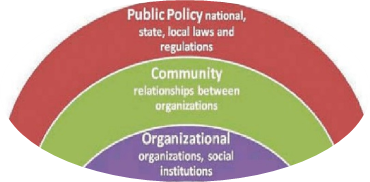
In reference to the socio-ecological framework, the last three layers apply to the resulting progress, although not a full solution, of the various community groups, resources, advocacy groups, and federal and provincial government calls to action in investigating the MMIWG epidemic. The model aligns with the current events, strategies for creating awareness, and the creation of public policies demonstrating the full application of the socio-ecologic approach.
Lastly, from the decades of outcry, demonstrations, media coverage, and demands
for inquiry and investigations, there are now safety and support measures with alert systems being implemented across Canada and the United States. One such program supported by aboriginalalert.ca provides weekly and monthly statistics for public viewing, as well as a link to connect with the organization’s group members on a missing family member or friend:


We share information about missing Aboriginal people in Canada across our site ... [and] are continually receiving and accessing information to share details about missing people and who to contact with information ... [e]ach profile has a link to print a Missing Poster that can be shared online or printed to be posted around your community (By The Numbers - Aboriginal Alert, n.d.).

Another alert system in the works was announced on December 3, 2023, known as “the Red Dress Alert, for missing Indigenous women, girls and two-spirited people, according to NDP Winnipeg Centre MP Leah Gazan (Matassa-Fung, 2023)”. The NDP MP added, “[w]e also know through a national inquiry that, should we go missing, the systems in place to protect us have not done what needs to be done to make sure we are safe and we are found” (Gazan as cited in Matassa-Fung, 2023). Since her election in 2019, Gazan said she has been advocating for the Canadian government to establish the Red Dress Alert system. She hopes to have the system installed and running in the new year (2023).
Once again, I see these responses of Government policymakers, organizations, and
social institutions demonstrating the Socio-Ecological framework and being applied to the focus of Community Health. These up-and-coming support organizations and previously established advocacy groups have continuously turned to social media since its inception, and continue to utilize this medium to have a voice, spread awareness, make connections, and develop a strong and empowered community.
(CBC Vancouver, 2023)
While this issue has not been fully resolved, nor is perfect, there is at least a bigger
awareness and understanding of this very long-standing historical subject, nationally and globally.
Red Dress Day - May 5
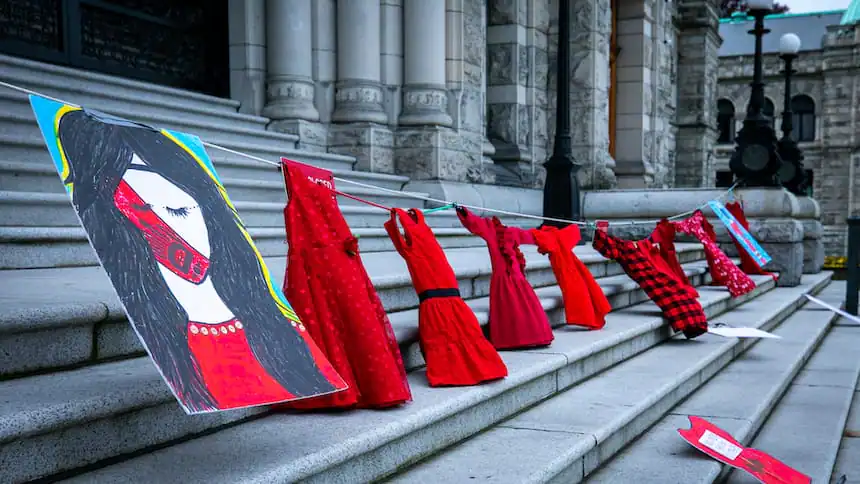
Red Dress Day was inspired in 2010 by Jamie Black, a Métis artist based in Winnipeg, Manitoba. Black hung hundreds of empty red dresses in public places to represent missing and murdered Indigenous women and girls and to bring awareness to the issue (Red Dress Day: What It Is and How It Began, 2023).
References
Aboriginal Alert - Canada’s Indigenous Awareness Network. (n.d.). Aboriginal Alert.
Brant, J. (2017). Missing and Murdered Indigenous Women and Girls in Canada. In Canadian
Encyclopedia. Retrieved December 1, 2023, from https://www.thecanadianencyclopedia.ca/en/article/missing-and-murdered-indigenous-women-and-
By the Numbers - Aboriginal Alert. (n.d.). Aboriginal Alert. https://www.aboriginalalert.ca/stats
Canada 150 and the decriminalization of Indigenous Sex Workers. (2017, June 30). AWID.
CBC News. (2015, April 10). CBC News launches investigation into cases of missing and murdered
indigenous women. [Video]. YouTube. https://www.youtube.com/watch?v=Jky5klsnwBY
CBC Vancouver. (2023, May 6). Missing and Murdered Indigenous Women and Girls
remembered [Video]. YouTube. https://www.youtube.com/watch?v=fY0-_xP9F-I
Federal program focuses on “root causes” of missing, murdered aboriginal women. (2014, September
10). CBC. https://www.cbc.ca/news/indigenous/federal-program-focuses-on-root-causes-of- missing-murdered-aboriginal-women-1.2762024
Government of Canada; Crown-Indigenous Relations and Northern Affairs Canada. (2023, June 29).
Report of the Roundtable on Missing and Murdered Indigenous Women, Girls and 2SLGBTQI+
Indigenous Americans. (2018, October 17). Canada’s missing and murdered Indigenous women [Video].
Lee, B. C., Bendixsen, C., Liebman, A. K., & Gallagher, S. S. (2017). Using the socio-ecological model to
frame agricultural safety and health interventions. Journal of Agromedicine.
Matassa-Fung, D. (2023, December 3). Canada begins consultations on alert system for missing Indigenous women, girls and two-spirit people. Global News. Retrieved December 4, 2023, from https://globalnews.ca/news/10145244/canada-consultations-missing-indigenous-alert-system/
Missing and Murdered Indigenous Women and Girls in Canada. (n.d.). The Canadian Encyclopedia. https://www.thecanadianencyclopedia.ca/en/article/missing-and-murdered- indigenous-women-and-girls-in-canada
Public Health Agency of Canada. (2023, June 1). Social determinants of health and health inequalities. Canada.ca. https://www.canada.ca/en/public-health/services/health-promotion/population- health/what-determines-health.html
Red Dress Day: What it is and how it began. (2023, May 5). Kids News. https://www.cbc.ca/kidsnews/post/red-dress-day-what-it-is-and-how-it-began#SnippetTab
The Canadian Press. (2014, August 21). National inquiry not best way to deal with missing, murdered women: Harper. CTVNews. https://www.ctvnews.ca/canada/national-inquiry-not-best-way-to- deal- with-missing-murdered-women-harper-1.1970407
The REDress Project – Jaime Black. (2020). https://www.jaimeblackartist.com/exhibitions/
United Steel Workers. (2019). Summary of the Final Report of the National Inquiry Into Missing and Murdered Indigenous Women and Girls. In USW-MMIWG. Retrieved December 3, 2023, from https://usw.ca/wp-content/uploads/2022/04/USW-MMIWG-Summary-Final-EN.pdf
Wu, G. (2016, January 26). What’s Happening with Aboriginal Women in Canada? HelloFlo. https://helloflo.com/this-countrys-leader-promises-much-needed-change-for-marginalized- aboriginal-women/
Z, L. (2019, June 28). Reclaiming Power and Place: The Final Report of the National Inquiry into Missing and Murdered Indigenous Women and Girls. MMIWG. https://www.mmiwg-ffada.ca/final-report/


Comments